


The Contributory Aged Parent Visa Subclass 864 is a permanent parent visa for eligible aged parents who are in Australia and have a settled Australian citizen, Australian permanent resident or eligible New Zealand citizen child.
This visa may be suitable for families seeking a permanent parent visa pathway where the parent is old enough to meet the aged parent requirement and can apply from within Australia.
- Permanent parent visa pathway
- For eligible aged parents in Australia
- Balance of Family Test generally applies
- Assurance of Support may be required
- Higher contributory visa charges may apply
What is the Contributory Aged Parent Visa Subclass 864?
The Contributory Aged Parent Visa Subclass 864 is a permanent visa that allows eligible aged parents to live in Australia permanently if they meet the relevant family, sponsorship, age, health, character and visa requirements.
This visa is part of Australia’s family migration program. It is called a “contributory” aged parent visa because it generally involves higher visa application charges than non-contributory aged parent pathways. In return, contributory parent visa pathways have historically been associated with shorter queues than non-contributory parent visas, although processing times can still be lengthy and may change over time.
The Subclass 864 visa is different from the Contributory Parent Visa Subclass 143 because Subclass 864 is an onshore aged parent visa. The applicant must generally be old enough to meet the aged parent requirement and must usually be in Australia when the application is lodged and when the visa is granted.
Eligibility, Sponsorship & Family Requirements
The Subclass 864 visa requires careful review of the applicant’s age, location, family structure, eligible sponsor, balance of family position and support requirements before lodgement.
Who Can Apply?
Applicants generally need to be aged parents of an eligible sponsor in Australia. The sponsor is usually an Australian citizen, Australian permanent resident or eligible New Zealand citizen who is settled in Australia.
- Eligible parent-child relationship
- Applicant must meet the aged parent requirement
- Applicant must usually be in Australia
- Eligible sponsor in Australia
- Balance of Family Test generally applies
- Health and character requirements
Sponsorship Requirements
The sponsor is commonly the applicant’s child. Sponsorship should be reviewed carefully, including the sponsor’s status, residence history, relationship to the applicant and ability to meet sponsorship obligations.
- Australian citizen, permanent resident or eligible New Zealand citizen
- Usually settled in Australia
- Willing to sponsor the aged parent visa applicant
- Prepared to meet relevant sponsorship obligations
Balance of Family Test
The Balance of Family Test is one of the most important requirements for the Subclass 864 visa. It considers the number and location of the applicant’s children and whether a sufficient proportion are living permanently in Australia.
Careful review may be required where there are stepchildren, adopted children, children from previous relationships, deceased children or children whose residence status is unclear.
Assurance of Support
An Assurance of Support may be required. This is a financial commitment intended to reduce the risk of the visa holder relying on certain Australian social security payments after the visa is granted.
The assurance process may involve income requirements and a financial bond, so families should plan for this requirement early.
Application Process, Benefits & Common Issues
Contributory aged parent visa applications can involve significant planning, supporting documents, long-term costs and bridging visa considerations.
Application Process
- Assess aged parent visa eligibility and age requirement
- Review current visa status and whether an onshore application is possible
- Review sponsor eligibility and settlement in Australia
- Check the Balance of Family Test
- Prepare identity, relationship and family evidence
- Lodge the visa application with supporting documents
- Respond to Department requests
- Complete health and character checks if required
- Address Assurance of Support requirements if requested
Key Benefits
- Permanent residence in Australia
- Ability to live in Australia permanently
- Ability to work and study in Australia
- Potential access to Medicare, subject to eligibility
- Travel facility attached to the permanent visa
- Potential pathway to Australian citizenship, subject to eligibility
- Onshore pathway for eligible aged parents
Common Challenges
- The applicant does not meet the aged parent requirement
- The applicant holds a visa with a No Further Stay condition
- The Balance of Family Test is misunderstood or incorrectly calculated
- The sponsor may not meet eligibility or settlement requirements
- Family relationships are difficult to document
- Health, character or previous visa issues require careful review
- Assurance of Support requirements are not planned early enough
When Professional Advice May Help
Professional migration advice may be useful where the applicant is unsure about the aged parent requirement, current visa conditions, bridging visa consequences, the Balance of Family Test or sponsor eligibility.
Advice may also help families compare Subclass 864 with other parent visa pathways and understand cost, timing and documentation risks before proceeding.
Visa Charges & Processing Times
Visa application charges and processing times change regularly. Applicants should review the latest official information published by the Department of Home Affairs before lodging an application.
Frequently Asked Questions
Common questions about the Contributory Aged Parent Visa Subclass 864, aged parent eligibility, sponsorship, Balance of Family Test, Assurance of Support and related parent visa pathways.
Is the Contributory Aged Parent Visa Subclass 864 a permanent visa?
Yes. The Subclass 864 visa is a permanent parent visa. If granted, it allows the visa holder to live in Australia permanently, subject to the conditions and travel facility attached to the visa.
Who can apply for a Subclass 864 visa?
The applicant generally needs to be an aged parent of a settled Australian citizen, Australian permanent resident or eligible New Zealand citizen. The applicant must also meet relevant visa, health, character, sponsorship and family requirements.
Do I need to be in Australia to apply for the Subclass 864 visa?
The Subclass 864 visa is an onshore aged parent visa. The applicant must generally be in Australia when the application is lodged and when the visa is granted.
What is the aged parent requirement for Subclass 864?
The primary applicant must be old enough to qualify as an aged parent under the relevant migration rules. This requirement should be checked carefully before lodging an application.
Does the Subclass 864 visa require the Balance of Family Test?
Yes. The Balance of Family Test generally applies to the Subclass 864 visa. It considers the number and location of the applicant’s children and whether a sufficient proportion are eligible children living in Australia.
Can the Balance of Family Test be waived?
The Balance of Family Test is a strict requirement and should not be assumed to be flexible. Families should assess this issue carefully before lodging a parent visa application.
Who can sponsor a Subclass 864 visa applicant?
The sponsor is usually the applicant’s child, who must generally be an Australian citizen, Australian permanent resident or eligible New Zealand citizen and settled in Australia.
Does the Subclass 864 visa require an Assurance of Support?
An Assurance of Support may be required. This process may involve income requirements and a financial bond and should be planned early in the parent visa process.
What is the difference between Subclass 864 and Subclass 143?
Both visas are permanent contributory parent visas. The main practical difference is that Subclass 864 is an onshore aged parent visa, while Subclass 143 is generally used as a contributory parent visa pathway that does not require the same aged parent onshore framework.
What is the difference between Subclass 864 and Subclass 804?
Both are aged parent visas, but Subclass 864 is a contributory aged parent visa and usually involves higher visa charges. Subclass 804 is a non-contributory aged parent visa and may have significantly longer processing expectations.
Can I apply for Subclass 864 if my current visa has a No Further Stay condition?
A No Further Stay condition can prevent an applicant from lodging another visa application while in Australia unless the condition is waived. This issue should be reviewed before attempting to lodge a Subclass 864 application.
Can I get a bridging visa after applying for Subclass 864?
Because Subclass 864 is an onshore visa, a bridging visa may be relevant after a valid application is lodged. However, bridging visa conditions and timing depend on the applicant’s current visa and individual circumstances.
Are Subclass 864 visa fees and processing times fixed?
No. Visa application charges and processing times can change. Applicants should always check the latest official information published by the Department of Home Affairs before lodging an application.
Which parent visa is best for my family?
There is no single best parent visa. The most suitable option depends on age, location, family structure, current visa status, expected processing times, total costs and whether the applicant may be eligible for other parent visa pathways.

Reviewed by Principal Migration Consultant
This page has been reviewed by Mohammad Reza Azimi, Principal Migration Consultant at Shada Migration. Mohammad has assisted clients with Australian migration matters since 2009 and holds a Graduate Certificate in Migration Law from the Australian National University (ANU).
Need Help with a Parent Visa Matter?
If you are considering a Contributory Aged Parent Visa, Sponsored Parent Visa, Contributory Parent Visa or another family migration pathway, we can help you understand the eligibility requirements, sponsorship obligations and available options.

The Sponsored Parent Visa Subclass 870 is a temporary parent visa that allows eligible parents of Australian citizens, Australian permanent residents or eligible New Zealand citizens to stay in Australia for an extended period.
This visa may be suitable for families who want a longer temporary parent visa option without immediately applying for a permanent parent visa.
- Temporary parent visa pathway
- Stay in Australia for up to 3 or 5 years
- No Balance of Family Test requirement
- No Assurance of Support requirement
- Maximum cumulative stay generally up to 10 years
What is the Sponsored Parent Visa Subclass 870?
The Sponsored Parent Visa Subclass 870 is a temporary visa that allows eligible parents to visit and stay in Australia for a longer period than a standard visitor visa.
This visa is designed for parents of Australian citizens, Australian permanent residents or eligible New Zealand citizens. It may allow a parent to stay in Australia for up to 3 years or up to 5 years, depending on the visa granted.
The Subclass 870 visa is different from permanent parent visas such as the Contributory Parent Visa Subclass 143, Contributory Aged Parent Visa Subclass 864 and Aged Parent Visa Subclass 804. It is temporary and does not itself provide permanent residence in Australia.
Eligibility, Sponsorship & Family Requirements
The Subclass 870 visa requires careful review of the parent applicant, the approved parent sponsor and the family relationship before lodgement.
Who Can Apply?
Applicants generally need to be the parent of an approved parent sponsor in Australia. The parent may be a biological parent, legal parent, adoptive parent, step-parent or parent-in-law, depending on the circumstances.
- Parent of an eligible sponsor
- Sponsor must be approved before the visa application
- Health and character requirements apply
- Adequate health insurance may be required
Approved Parent Sponsor Requirements
The sponsor must usually be an Australian citizen, Australian permanent resident or eligible New Zealand citizen. The sponsor must first apply to become an approved parent sponsor before the parent can apply for the Subclass 870 visa.
- Approved parent sponsor required
- Usually the applicant’s child or eligible family sponsor
- Sponsorship approval must be in place before visa lodgement
- Sponsorship obligations should be understood before applying
Balance of Family Test
The Subclass 870 visa does not require the applicant to satisfy the Balance of Family Test. This is one of the important differences between the 870 visa and many permanent parent visa pathways.
This may make the Subclass 870 visa relevant for families where the parent does not meet the Balance of Family Test for permanent parent visas.
Health Insurance
Applicants may need to show that they have adequate health insurance arrangements for their stay in Australia. This is important because the Subclass 870 visa is a temporary visa and does not automatically provide the same benefits as permanent residence.
Families should plan health insurance carefully before applying.
Application Process, Benefits & Common Issues
The Subclass 870 visa involves two main stages: sponsorship approval and the visa application itself.
Application Process
- Assess whether the sponsor may be eligible
- Apply for parent sponsorship approval
- Wait for sponsorship approval before lodging the visa application
- Prepare parent identity, relationship and family evidence
- Prepare health insurance evidence if required
- Lodge the Subclass 870 visa application
- Respond to Department requests
- Complete health, character or biometrics requirements if requested
Key Benefits
- Longer stay than a standard visitor visa
- May allow a stay of up to 3 or 5 years
- No Balance of Family Test requirement
- No Assurance of Support requirement
- Can help families spend extended time together in Australia
- May be considered while permanent parent visa options are being reviewed
Common Challenges
- The sponsor has not obtained sponsorship approval before the visa application
- The family relationship is not properly documented
- Health insurance requirements are misunderstood
- Applicants assume the visa leads directly to permanent residence
- Families misunderstand the maximum cumulative stay period
- Previous visa refusals, cancellations or compliance issues require careful review
When Professional Advice May Help
Professional migration advice may be useful where sponsor eligibility is uncertain, the parent has previous visa issues, health concerns, complex family relationships or uncertainty about whether a temporary or permanent parent visa pathway is more suitable.
Advice may also help families compare the Subclass 870 visa with permanent parent visa options such as Subclass 143, Subclass 864 and Subclass 804.
Visa Charges & Processing Times
Visa application charges and processing times change regularly. Applicants should review the latest official information published by the Department of Home Affairs before lodging an application.
Frequently Asked Questions
Common questions about the Sponsored Parent Visa Subclass 870, eligibility, sponsorship, visa duration, health insurance and how this visa differs from permanent parent visa pathways.
Is the Sponsored Parent Visa Subclass 870 a permanent visa?
No. The Subclass 870 visa is a temporary parent visa. It allows eligible parents to stay in Australia for an extended temporary period, but it does not provide permanent residence and does not lead directly to Australian citizenship.
How long can a parent stay in Australia on a Subclass 870 visa?
The visa may allow a parent to stay in Australia for up to 3 years or up to 5 years, depending on the visa granted. The total cumulative stay under the Subclass 870 visa program is generally limited to 10 years.
Does the Subclass 870 visa require the Balance of Family Test?
No. The Subclass 870 visa does not require the Balance of Family Test. This is an important difference between the 870 visa and many permanent parent visas, including Subclass 143, Subclass 864 and Subclass 804.
Does the Subclass 870 visa require an Assurance of Support?
No. The Subclass 870 visa generally does not require an Assurance of Support. This can make it different from some permanent parent visa pathways where financial support requirements may be part of the process.
Who can sponsor a Subclass 870 visa applicant?
The sponsor must generally be an approved parent sponsor who is an Australian citizen, Australian permanent resident or eligible New Zealand citizen. Sponsorship approval must usually be obtained before the parent lodges the visa application.
Can I apply for the 870 visa before sponsorship is approved?
No. The sponsorship stage is separate from the visa application stage. The sponsor usually needs to be approved as a parent sponsor before the parent can apply for the Subclass 870 visa.
Can a parent work in Australia on a Subclass 870 visa?
The Subclass 870 visa is intended as a temporary parent visa, not a work visa. Visa holders should carefully check the conditions attached to their visa grant before undertaking any activity in Australia.
Is health insurance required for the Sponsored Parent Visa?
Applicants may need to maintain adequate health insurance arrangements while in Australia. Families should review health insurance requirements carefully before applying and during the visa holder’s stay in Australia.
Can both parents apply for a Subclass 870 visa?
In some families, both parents may wish to apply. The correct approach depends on sponsor eligibility, sponsorship limits, family circumstances and timing. It is important to check whether the proposed sponsorship arrangement can support the intended applications.
Can I apply for a permanent parent visa while holding a Subclass 870 visa?
The Subclass 870 visa does not itself lead to permanent residence. Some families may still consider separate permanent parent visa pathways, but the timing, eligibility and visa strategy should be reviewed carefully before proceeding.
What is the difference between Subclass 870 and Subclass 143?
The Subclass 870 visa is temporary and allows an extended stay in Australia for eligible parents. The Subclass 143 visa is a permanent contributory parent visa. The two visas have different eligibility requirements, costs, processing considerations and long-term outcomes.
What is the difference between a Visitor Visa and the Subclass 870 visa?
A Visitor Visa is usually designed for shorter temporary visits. The Subclass 870 visa is specifically designed for eligible parents who wish to stay with family in Australia for a longer temporary period, subject to sponsorship and visa requirements.
What are common problems in Subclass 870 applications?
Common problems include lodging before sponsorship approval, weak relationship evidence, misunderstanding health insurance requirements, sponsor eligibility issues, previous visa compliance concerns and assuming the visa is a permanent migration pathway.
Which parent visa is best for my family?
There is no single best parent visa for every family. The most suitable pathway depends on the parent’s age, family structure, sponsor eligibility, budget, processing expectations, long-term migration goals and whether permanent residence is required.
Reviewed by Principal Migration Consultant
This page has been reviewed by Mohammad Reza Azimi, Principal Migration Consultant at Shada Migration. Mohammad has assisted clients with Australian migration matters since 2009 and holds a Graduate Certificate in Migration Law from the Australian National University (ANU).
Need Help with a Parent Visa Matter?
If you are considering a Sponsored Parent Visa, Contributory Parent Visa, Aged Parent Visa or another family migration pathway, we can help you understand the eligibility requirements, sponsorship obligations and available options.
The Contributory Parent Visa Subclass 143 is a permanent family migration visa for eligible parents of settled Australian citizens, Australian permanent residents or eligible New Zealand citizens.
This visa may be suitable for families seeking a permanent parent migration pathway where sponsorship, family eligibility, the balance of family test, health, character and assurance of support requirements need to be carefully assessed.
- Permanent parent visa pathway
- For eligible parents of settled Australian sponsors
- Balance of family test generally applies
- Assurance of support may be required
What is the Contributory Parent Visa Subclass 143?
The Contributory Parent Visa Subclass 143 is a permanent visa that allows eligible parents to live in Australia permanently if they meet the relevant family, sponsorship and visa requirements.
This visa is part of Australia’s family migration program. It is called a “contributory” parent visa because it generally involves a higher visa application charge than non-contributory parent visa pathways. In return, contributory parent visas have historically been associated with shorter queues than non-contributory parent visas, although processing times can still be lengthy and change over time.
The Subclass 143 visa is not simply a form-based application. Applicants and sponsors usually need to consider family structure, sponsor eligibility, the balance of family test, financial support requirements, health and character issues, and whether another parent visa pathway may be more appropriate.
Eligibility, Sponsorship & Family Requirements
The Subclass 143 visa requires careful review of the applicant’s family structure, eligible sponsor, balance of family position and support requirements before lodgement.
Who Can Apply?
Applicants generally need to be the parent of an eligible sponsor in Australia. The sponsor is usually an Australian citizen, Australian permanent resident or eligible New Zealand citizen who is settled in Australia.
- Eligible parent-child relationship
- Eligible sponsor in Australia
- Balance of family test generally applies
- Health and character requirements
Sponsorship Requirements
The sponsor is commonly the applicant’s child. Sponsorship should be reviewed carefully, including the sponsor’s status, residence history, relationship to the applicant and ability to meet sponsorship obligations.
- Australian citizen, permanent resident or eligible New Zealand citizen
- Usually settled in Australia
- Willing to sponsor the parent visa applicant
- Prepared to meet relevant sponsorship obligations
Balance of Family Test
The balance of family test is one of the most important parent visa requirements. It considers the number and location of the applicant’s children and whether a sufficient proportion are living permanently in Australia.
Careful review may be required where there are stepchildren, adopted children, children from previous relationships, deceased children or children whose residence status is unclear.
Assurance of Support
An Assurance of Support may be required. This is a financial commitment intended to reduce the risk of the visa holder relying on certain Australian social security payments after arrival.
The assurance process may involve income requirements and a financial bond, so families should plan for this requirement early.
Application Process, Benefits & Common Issues
Parent visa applications can involve significant planning, supporting documents and long-term family migration considerations.
Application Process
- Assess parent visa eligibility and family structure
- Review sponsor eligibility and settlement in Australia
- Check the balance of family test
- Prepare identity, relationship and family evidence
- Lodge the visa application with supporting documents
- Respond to Department requests
- Complete health and character checks if required
- Address assurance of support requirements if requested
Key Benefits
- Permanent residence in Australia
- Ability to live in Australia permanently
- Ability to work and study in Australia
- Potential access to Medicare, subject to eligibility
- Travel facility attached to the permanent visa
- Potential pathway to Australian citizenship, subject to eligibility
Common Challenges
- The balance of family test is misunderstood or incorrectly calculated
- The sponsor may not meet eligibility or settlement requirements
- Family relationships are difficult to document
- Health, character or previous visa issues require careful review
- Assurance of support requirements are not planned early enough
- Families underestimate likely costs or processing timeframes
When Professional Advice May Help
Professional migration advice may be useful where the balance of family test is uncertain, sponsor eligibility needs review, or the applicant has health, character or previous visa issues.
Advice may also help families compare Subclass 143 with other parent visa pathways and understand cost, timing and documentation risks before proceeding.
Visa Charges & Processing Times
Visa application charges and processing times change regularly. Applicants should review the latest official information published by the Department of Home Affairs before lodging an application.
Frequently Asked Questions
Common questions about the Contributory Parent Visa Subclass 143, sponsorship, balance of family requirements, costs and related parent visa pathways.
Is the Contributory Parent Visa Subclass 143 a permanent visa?
Yes. The Subclass 143 visa is a permanent parent visa. If granted, it allows the visa holder to live in Australia permanently, subject to the conditions and travel facility attached to the visa.
Who can sponsor a Subclass 143 parent visa applicant?
The sponsor is usually the applicant’s child, who must generally be an Australian citizen, Australian permanent resident or eligible New Zealand citizen and settled in Australia.
What is the balance of family test?
The balance of family test considers the number and location of the applicant’s children. It is a key requirement for many parent visa applications and should be assessed carefully before lodgement.
Does the Subclass 143 visa require an Assurance of Support?
An Assurance of Support may be required. This process is usually assessed separately and may involve income requirements and a financial bond.
Are parent visa fees and processing times fixed?
No. Visa application charges and processing times can change. Applicants should always check the latest official information published by the Department of Home Affairs before lodging an application.
Should I choose Subclass 143 or another parent visa?
This depends on factors such as age, location, family structure, expected processing times, total costs and whether the applicant may be eligible for other parent visa pathways. Professional advice may help compare available options.
Book a Parent Visa Consultation
Need help assessing a parent visa pathway, sponsorship requirements, the balance of family test or related family migration options?
Connect With Shada Migration
Follow Shada Migration through our official channels for migration updates, practical insights, announcements and community information.




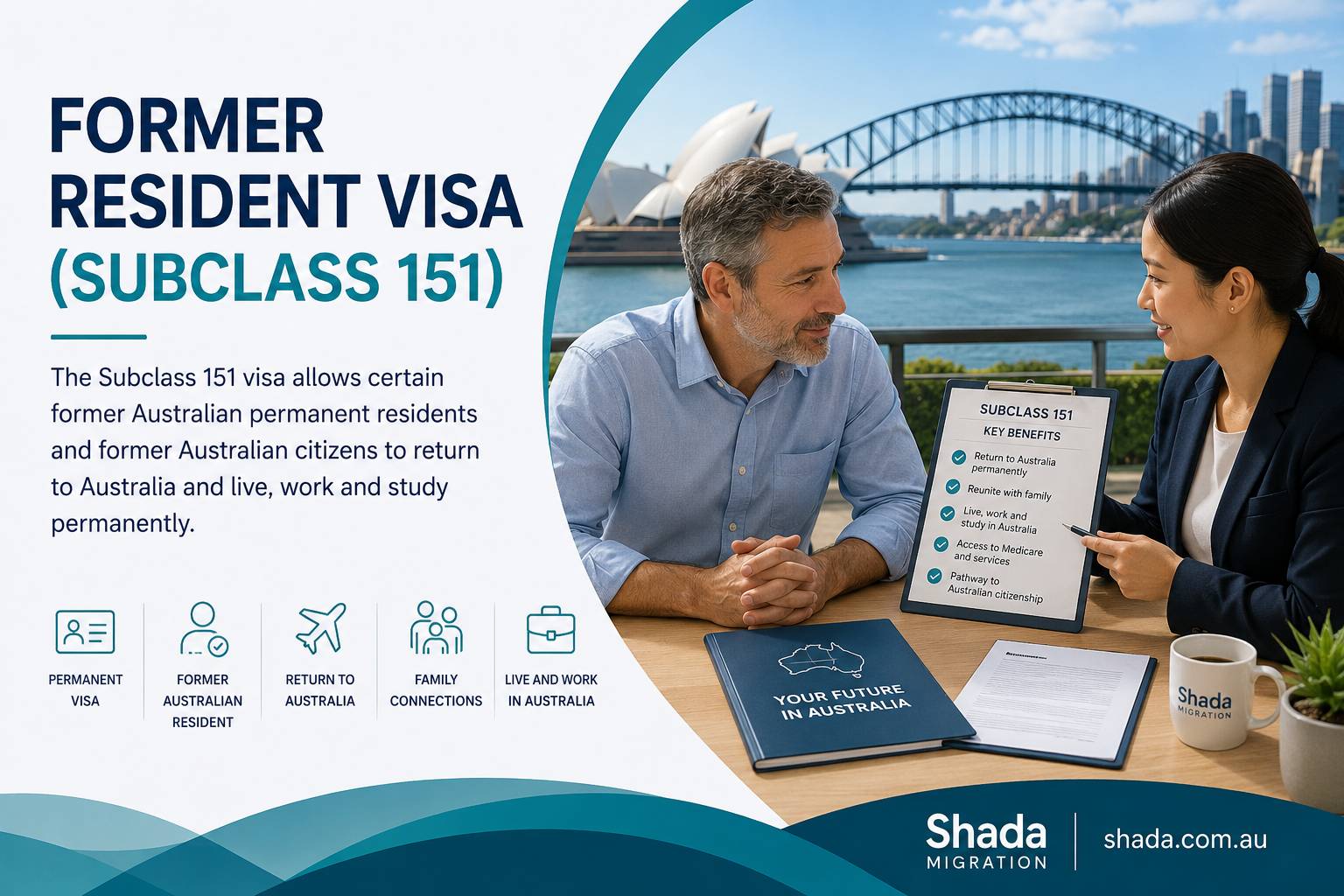
The Former Resident Visa (Subclass 151) is a permanent visa that allows certain former Australian permanent residents and former Australian citizens to return to Australia and live permanently.
Although the Subclass 151 visa is a relatively uncommon visa pathway, it may provide an important opportunity for eligible individuals who have previously lived in Australia and wish to re-establish their lives here.
- Permanent visa pathway
- For eligible former Australian residents
- Available in limited circumstances
- Allows permanent residence in Australia
- May assist eligible former Australian citizens and permanent residents
What is the Former Resident Visa (Subclass 151)?
The Former Resident Visa (Subclass 151) is a permanent visa designed for certain people who previously held Australian permanent residence or Australian citizenship and who satisfy the legislative requirements for this visa.
This visa recognises that some individuals have strong historical ties to Australia and may wish to return and permanently re-establish themselves in Australia after living overseas.
Unlike most family migration pathways, the Subclass 151 visa is not based on sponsorship by a family member. Instead, eligibility is generally connected to the applicant's previous status and historical connection with Australia.
Who Can Apply?
The Subclass 151 visa is intended for a limited group of applicants who meet specific legislative requirements.
Former Australian Citizens
Certain former Australian citizens may be eligible to apply if they satisfy the visa requirements.
Former Permanent Residents
Some former Australian permanent residents may qualify under the relevant legislative criteria.
Historical Australian Ties
Applicants generally need to demonstrate a qualifying historical connection with Australia.
Permanent Migration Outcome
The visa provides a permanent residence outcome for eligible applicants.
Eligibility Requirements
Eligibility for the Former Resident Visa can be complex and depends on an applicant's individual history, previous status in Australia and compliance with the legislative requirements applicable at the time of application.
- Meet the relevant former resident eligibility criteria
- Demonstrate the required historical connection with Australia
- Satisfy health requirements
- Satisfy character requirements
- Meet all visa-specific legislative requirements
Because this visa applies to a relatively small group of applicants, professional advice may assist in determining eligibility.
Permanent Residence Benefits
The Subclass 151 visa grants permanent residence to successful applicants.
Permanent residents may generally live, work and study in Australia and access a range of rights and opportunities available to Australian permanent residents, subject to relevant laws and eligibility requirements.
Health and Character Requirements
Applicants must generally satisfy Australia's health and character requirements before a visa can be granted.
Health examinations, police clearances and other supporting evidence may be required depending on the applicant's circumstances.
Important Considerations
The Former Resident Visa is a specialised visa category and is not suitable for most applicants seeking migration to Australia.
Individuals who do not satisfy the Subclass 151 criteria may need to consider alternative migration pathways, including family migration, skilled migration, employer-sponsored visas or citizenship-related options.
Benefits of the Former Resident Visa
The Former Resident Visa (Subclass 151) provides eligible applicants with an opportunity to permanently return to Australia and re-establish their lives.
Permanent Residence
Successful applicants receive Australian permanent residence.
Live and Work in Australia
Eligible visa holders can live, work and study in Australia permanently.
Reconnect with Australia
Provides a pathway for eligible former residents to return and rebuild their lives in Australia.
Access Permanent Resident Benefits
Permanent residents may access various rights and opportunities available under Australian law.
Who Is This Visa Designed For?
The Former Resident Visa is designed for a relatively small group of applicants with a qualifying historical connection to Australia.
Unlike most family migration visas, the Subclass 151 visa is not based on sponsorship by a spouse, child or other family member. Instead, eligibility is linked to the applicant's previous Australian status and specific legislative requirements.
Because the eligibility rules are highly specialised, applicants should carefully review the requirements before lodging an application.
Alternative Migration Pathways
If you are not eligible for the Former Resident Visa, there may be other visa options available depending on your circumstances.
Partner Visas
Migration pathways for spouses and de facto partners of Australian citizens and permanent residents.
Child Visas
Permanent visa pathways for eligible children of Australian citizens and permanent residents.
Parent Visas
Various parent visa pathways for eligible parents of settled Australians.
Visa Assessment
Explore alternative migration options based on your personal circumstances.
Frequently Asked Questions
Is the Subclass 151 visa a permanent visa?
Yes. The Former Resident Visa is a permanent residence visa.
Do I need a sponsor for this visa?
No. Unlike most family migration visas, the Subclass 151 visa is generally not based on sponsorship by a family member.
Can former Australian citizens apply?
Certain former Australian citizens may be eligible if they satisfy the legislative requirements for the visa.
Can former Australian permanent residents apply?
Some former Australian permanent residents may qualify depending on their circumstances and immigration history.
Do health and character requirements apply?
Yes. Applicants must generally satisfy Australia's health and character requirements.
Is the Subclass 151 visa common?
No. This is a specialised visa category that applies to a relatively small number of applicants.
Can this visa lead to Australian citizenship?
As a permanent resident, a visa holder may become eligible to apply for Australian citizenship in the future if all citizenship requirements are met.
Reviewed by Principal Migration Consultant
This page has been reviewed by Mohammad Reza Azimi, Principal Migration Consultant at Shada Migration. Mohammad has assisted clients with Australian migration matters since 2009 and holds a Graduate Certificate in Migration Law from the Australian National University (ANU).
Need Advice About a Former Resident Visa?
The Subclass 151 visa is a specialised visa category with unique eligibility requirements. Professional advice may help determine whether you qualify and whether alternative migration pathways may be available.

One of the most important issues in Australian child visa applications is whether the child can lawfully migrate to Australia when custody, guardianship or parental responsibility arrangements exist.
The Department of Home Affairs must be satisfied that granting a visa to a child will not improperly interfere with the rights of another parent or person who has legal responsibility for the child.
Applications involving separated parents, divorce, international custody arrangements or parental disputes often require additional evidence and careful preparation.
- Child Visa (Subclass 101)
- Child Visa (Subclass 802)
- Dependent Child Visa (Subclass 445)
- Adoption Visa (Subclass 102)
- Orphan Relative Visa (Subclass 117 & 837)
Why Custody and Consent Matter
Australian migration law places significant emphasis on protecting the interests of children. Before granting a visa to a child, the Department must be satisfied that the child's migration to Australia is lawful and consistent with parental responsibility arrangements.
Where one parent remains overseas or another person has legal responsibility for the child, additional evidence may be required before a visa can be granted.
Failure to address custody and consent issues is one of the most common reasons for delays in child visa applications.
Who Has Legal Responsibility for a Child?
The Department may consider who has legal responsibility for the child under the laws of the country where the child resides and any relevant court orders.
Both Parents
Many children remain subject to joint parental responsibility arrangements.
Sole Custody
One parent may hold sole parental responsibility under a court order.
Guardians
Guardians or other legally appointed persons may have responsibility for the child.
Court Appointments
Responsibility may be determined through family court proceedings.
When Is Parental Consent Required?
Where another parent has legal responsibility for the child, the Department may require evidence that the parent consents to the child's migration to Australia.
Consent requirements vary depending on the child's circumstances, the country involved and any custody or family court orders that may exist.
In some cases, a court order may remove the need for consent from another parent.
Court Orders and Custody Arrangements
Where family court orders exist, they often play a critical role in determining whether a child visa can be granted.
The Department may review custody orders, parenting orders, guardianship orders and other legal documents to determine who has authority to make decisions regarding the child's migration.
Common situations include:
- Parents who are separated or divorced
- Children living primarily with one parent
- Shared parental responsibility arrangements
- International custody disputes
- Guardianship arrangements involving relatives
- Orders restricting overseas travel
Where court orders are unclear or incomplete, additional evidence may be requested before a visa decision can be made.
Evidence Commonly Required
The exact documentation required will depend on the child's circumstances. However, applicants are often asked to provide evidence demonstrating parental responsibility and consent arrangements.
Birth Certificates
Evidence confirming the identity of the child and parents.
Court Orders
Custody, parenting and guardianship orders where applicable.
Consent Documents
Written consent from another parent where required.
Identity Documents
Passports and identification records for relevant family members.
Ministerial Direction 80 and Child Welfare Considerations
When assessing child visa applications, the Department may consider broader child welfare principles and Australia's obligations relating to the protection of children.
The primary concern is ensuring that granting a visa does not improperly remove a child from the lawful care of another parent or guardian.
Applications involving allegations of parental conflict, child abduction concerns or unresolved custody disputes often require particularly careful assessment.
Frequently Asked Questions
Does the other parent always need to consent?
Not necessarily. The requirement depends on who has legal responsibility for the child and whether court orders exist that address parental responsibility or international travel.
What happens if the other parent refuses consent?
The application may require additional evidence or family court orders addressing the child's migration to Australia.
Can sole custody remove the need for consent?
In many cases, evidence that one parent has sole parental responsibility may reduce or remove the need for consent from another parent.
What if the other parent's location is unknown?
The Department may require evidence of efforts made to locate the parent and may assess the circumstances on a case-by-case basis.
Do custody requirements apply to Subclass 101 and Subclass 802 visas?
Yes. Custody and parental responsibility considerations commonly arise in both offshore and onshore child visa applications.
What documents are most commonly requested?
Birth certificates, custody orders, parenting orders, consent documents, passports and guardianship evidence are frequently requested.
Can a visa be refused because of custody issues?
Yes. Where the Department is not satisfied that the child can lawfully migrate to Australia, custody and consent issues may affect the outcome of the application.
Why are custody issues one of the most common causes of delay?
Applications involving children require careful assessment of parental responsibility arrangements and child welfare considerations, often requiring additional evidence and legal documentation.
Reviewed by Principal Migration Consultant
This page has been reviewed by Mohammad Reza Azimi, Principal Migration Consultant at Shada Migration. Mohammad has assisted clients with Australian migration matters since 2009 and holds a Graduate Certificate in Migration Law from the Australian National University (ANU).
Need Advice on Child Visa Custody Issues?
Custody arrangements, parental responsibility and consent requirements can significantly affect child visa applications. Professional advice may help identify the appropriate evidence and reduce the risk of delays or refusal.