


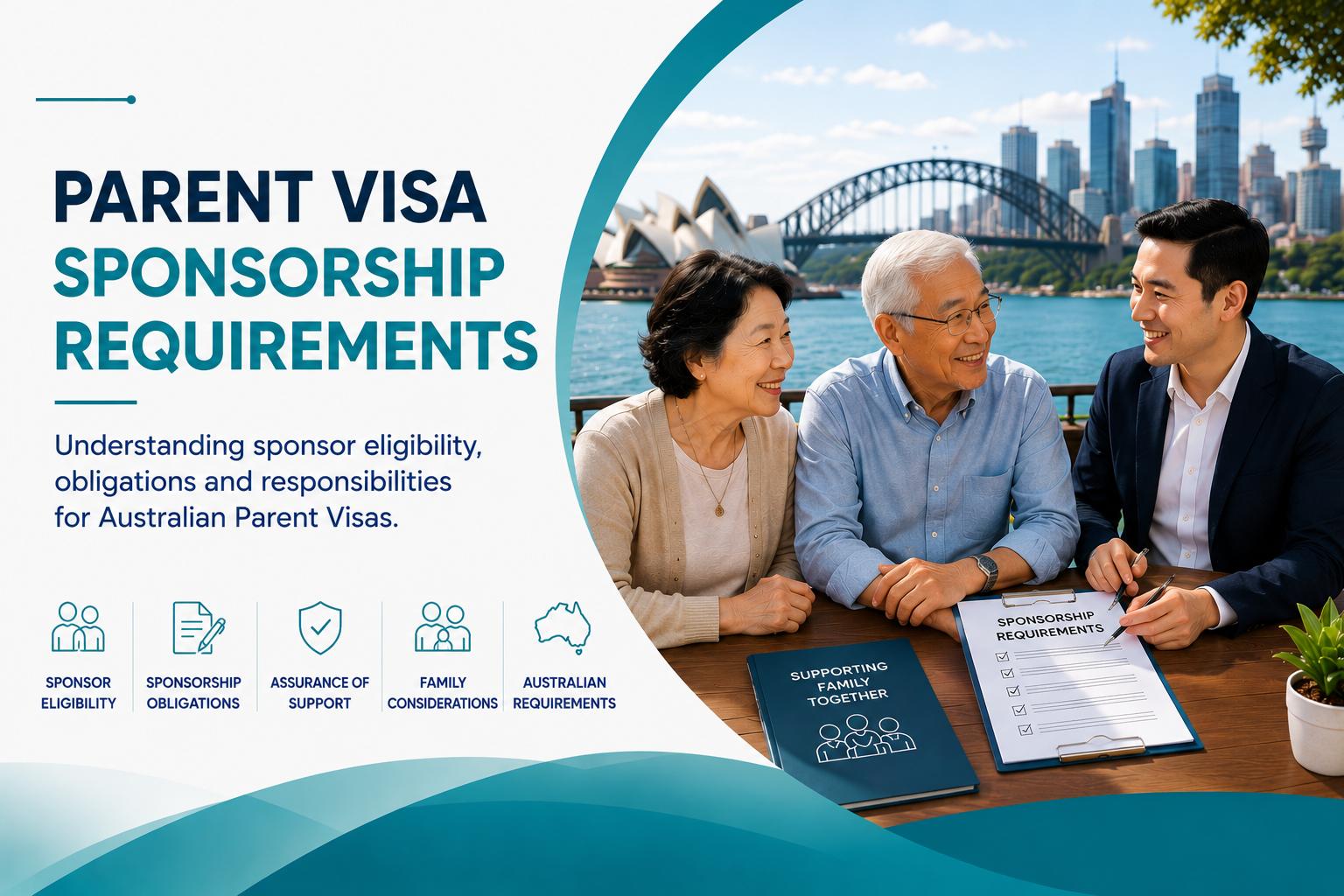
Understanding Parent Visa Sponsorship Requirements is an important part of planning an Australian parent visa application.
Most Australian parent visa pathways require sponsorship by an eligible family member. Sponsors may have legal responsibilities and ongoing obligations associated with the visa process.
Before lodging a parent visa application, families should understand who can act as a sponsor, the requirements sponsors must satisfy and the responsibilities that may continue after visa grant.
- Understand who can sponsor a parent visa
- Learn sponsor eligibility requirements
- Review sponsor responsibilities and obligations
- Understand the relationship between sponsorship and Assurance of Support
- Explore common parent visa pathways
Why Is Sponsorship Required?
Sponsorship is a fundamental requirement for many Australian parent visa pathways. The sponsorship framework helps establish a genuine family connection and identifies a person who is prepared to support the applicant during the migration process.
The sponsor may be required to satisfy specific eligibility requirements and may have responsibilities that continue beyond the visa grant stage.
Because sponsorship forms part of the overall visa framework, it should be carefully considered before an application is prepared or lodged.
Who Can Sponsor a Parent Visa?
In many cases, the sponsor will be the applicant's child who is living in Australia. However, sponsorship arrangements can vary depending on the visa subclass and individual circumstances.
Sponsors generally need to satisfy legal eligibility requirements before sponsorship can be approved.
Australian Citizens
Many parent visa sponsors are Australian citizens who meet the applicable sponsorship requirements.
Permanent Residents
Australian permanent residents may also be eligible to sponsor a parent visa application.
Eligible New Zealand Citizens
Some eligible New Zealand citizens may be able to sponsor a parent visa application.
Relationship Requirements
The relationship between the sponsor and applicant must generally satisfy the relevant legislative requirements.
Sponsor Obligations
Becoming a sponsor involves more than simply signing a sponsorship form. Sponsors may have ongoing obligations associated with the visa pathway.
Support Responsibilities
Sponsors may be expected to assist and support applicants after arrival.
Compliance Obligations
Certain sponsorship obligations may continue for a specified period.
Accurate Information
Sponsors should ensure information provided throughout the process is accurate and complete.
Sponsorship vs Assurance of Support
Sponsorship and Assurance of Support are often confused, but they are different legal requirements.
A sponsor is the person supporting the visa application itself. An assurer is the person or organisation that may accept financial obligations under an Assurance of Support arrangement.
In some cases the sponsor and assurer may be the same individual, but this is not always the case.
For more information, see our Parent Visa Assurance of Support Guide.
Parent Visa Pathways Requiring Sponsorship
Sponsorship is a key component of several Australian parent visa pathways. Understanding the requirements of each visa can help families identify the most suitable option for their circumstances.
Contributory Parent Visa (Subclass 143)
Permanent parent visa pathway for eligible parents sponsored by an eligible family member in Australia.
View Subclass 143Sponsored Parent Visa (Subclass 870)
Temporary parent visa pathway specifically built around sponsorship arrangements.
View Subclass 870Contributory Aged Parent Visa (Subclass 864)
Permanent aged parent visa pathway requiring sponsorship and other eligibility criteria.
View Subclass 864Aged Parent Visa (Subclass 804)
Permanent visa option for eligible aged parents with an approved sponsor.
View Subclass 804Frequently Asked Questions
Can I sponsor my parent if I am an Australian permanent resident rather than an Australian citizen?
In many situations, Australian permanent residents may be eligible to sponsor a parent visa application. Eligibility depends on the visa subclass and the specific sponsorship requirements that apply.
Can more than one child be involved in a parent visa sponsorship application?
Depending on the circumstances, multiple family members may be relevant to the overall parent visa assessment, particularly when considering family relationships and eligibility requirements.
Does sponsorship automatically satisfy the Assurance of Support requirement?
No. Sponsorship and Assurance of Support are separate legal requirements. Meeting sponsorship requirements does not automatically satisfy any Assurance of Support obligations.
Can a parent visa application be refused if sponsorship requirements are not met?
Sponsorship forms part of the overall eligibility framework. If sponsorship requirements are not satisfied, this may affect the viability of the application.
Can a sponsor live outside Australia?
The sponsorship requirements vary between visa subclasses. Applicants should review the specific rules applicable to the visa pathway they intend to pursue.
What responsibilities does a sponsor have after the visa is granted?
Sponsor obligations vary depending on the visa subclass and legislative framework. Some obligations may continue after visa grant for a specified period.
Can sponsorship requirements change over time?
Migration legislation and policy settings can change. Applicants and sponsors should always rely on current requirements when preparing a visa strategy.
Should families assess sponsorship eligibility before preparing a parent visa application?
Yes. Sponsorship is a fundamental requirement for many parent visa pathways, so it is generally sensible to assess sponsorship eligibility at an early stage.

Reviewed by Principal Migration Consultant
This page has been reviewed by Mohammad Reza Azimi, Principal Migration Consultant at Shada Migration. Mohammad has assisted clients with Australian migration matters since 2009 and holds a Graduate Certificate in Migration Law from the Australian National University (ANU).
Need Help Understanding Parent Visa Sponsorship Requirements?
Parent visa sponsorship requirements can vary depending on the visa subclass and family circumstances. Understanding sponsor eligibility, sponsorship obligations, Assurance of Support considerations and visa-specific requirements can help families make informed decisions about available parent visa pathways.
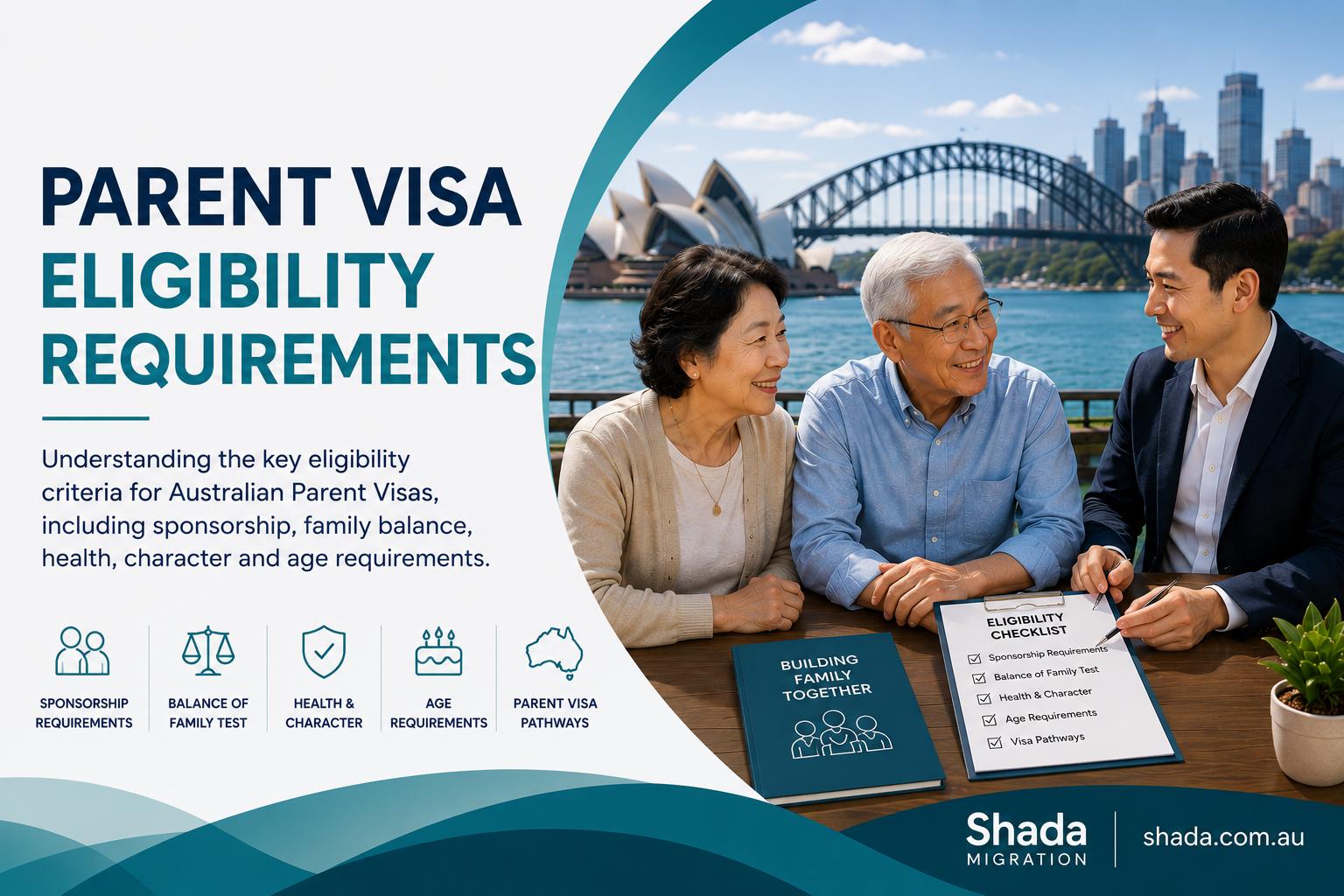
Understanding the Parent Visa Eligibility Requirements is one of the most important steps when planning a parent visa application for Australia.
Australia offers several parent visa pathways, each with its own requirements and eligibility criteria. While the specific requirements vary depending on the visa subclass, many parent visa pathways share common eligibility factors.
- Understand the main parent visa eligibility requirements
- Learn about sponsorship requirements
- Review the Balance of Family Test
- Understand health and character requirements
- Compare common parent visa pathways
Who Can Apply for a Parent Visa?
Australian parent visas are designed to allow eligible parents of Australian citizens, Australian permanent residents or eligible New Zealand citizens to migrate to Australia.
The specific requirements vary depending on the visa subclass, but parent visa applicants generally need to satisfy a number of legal, health and eligibility criteria before a visa can be granted.
Some parent visa pathways are temporary, while others provide a pathway to permanent residence. Understanding the available visa options is an important part of the planning process.
Sponsorship Requirements
Most parent visa pathways require sponsorship by an eligible child or, in some circumstances, another eligible sponsor.
The sponsor may have responsibilities that continue after visa grant and may need to satisfy specific eligibility requirements.
Eligible Sponsor
The sponsor must generally be an Australian citizen, Australian permanent resident or eligible New Zealand citizen.
Sponsor Obligations
Sponsors may have ongoing obligations and responsibilities associated with the visa.
Balance of Family Test
The Balance of Family Test is one of the most important eligibility requirements for many parent visa subclasses.
The test generally examines where an applicant's children are living and whether the required family balance exists in Australia.
Several permanent parent visa pathways require applicants to satisfy the Balance of Family Test before a visa can be granted.
For a detailed explanation, see our Parent Visa Balance of Family Test Guide.
Health and Character Requirements
Parent visa applicants are generally required to satisfy Australia's health and character requirements.
Health examinations may be required, and applicants may also need to provide police clearance certificates or other evidence relevant to character assessments.
The specific requirements can vary depending on personal circumstances and visa subclass.
Aged Parent Visa Requirements
Certain parent visa pathways are specifically available to parents who meet the Australian pension age requirements.
Aged parent visas may provide additional options for eligible applicants who are already in Australia and satisfy the relevant age criteria.
Eligibility requirements can vary between visa subclasses, and applicants should carefully review the requirements that apply to their circumstances.
Age Requirement
Applicants must generally satisfy the age criteria applicable to the aged parent visa pathway.
Location Requirement
Some aged parent visa pathways may require applicants to be in Australia at the time of application.
Common Parent Visa Pathways
Australia offers several parent visa pathways. The most suitable option depends on individual circumstances, eligibility requirements and long-term migration goals.
Contributory Parent Visa (Subclass 143)
Permanent parent visa pathway for eligible parents who satisfy the relevant requirements.
View Subclass 143Sponsored Parent Visa (Subclass 870)
Temporary parent visa pathway allowing eligible parents to stay in Australia for extended periods.
View Subclass 870Contributory Aged Parent Visa (Subclass 864)
Permanent onshore parent visa pathway for eligible aged parents.
View Subclass 864Aged Parent Visa (Subclass 804)
Permanent parent visa pathway for eligible aged parents meeting the relevant requirements.
View Subclass 804Frequently Asked Questions
Who can sponsor a parent visa?
Sponsors are generally Australian citizens, Australian permanent residents or eligible New Zealand citizens who satisfy the relevant sponsorship requirements.
Do all parent visas require the Balance of Family Test?
Not all parent visa subclasses operate in the same way. Applicants should review the requirements of the specific visa pathway they intend to pursue.
Do parent visa applicants need health examinations?
Many parent visa applicants are required to satisfy health requirements and may need to undergo medical examinations.
Can parents apply while outside Australia?
Some parent visa pathways are available offshore, while others may require applicants to be in Australia. Requirements depend on the visa subclass.
What is the difference between contributory and non-contributory parent visas?
The two pathways differ in eligibility requirements, government charges and processing considerations.
Is there an age requirement for all parent visas?
No. Age requirements apply differently depending on the visa subclass. Some pathways specifically require applicants to satisfy aged parent criteria.
Do parent visa applicants need an Assurance of Support?
Certain parent visa pathways may require an Assurance of Support. Applicants should review the requirements applicable to their chosen visa.
What is the first step before applying for a parent visa?
Families should first determine which parent visa pathway may be available and assess eligibility requirements before preparing an application.
Reviewed by Principal Migration Consultant
This page has been reviewed by Mohammad Reza Azimi, Principal Migration Consultant at Shada Migration. Mohammad has assisted clients with Australian migration matters since 2009 and holds a Graduate Certificate in Migration Law from the Australian National University (ANU).
Need Help Understanding Parent Visa Eligibility?
Determining eligibility for an Australian Parent Visa can involve sponsorship requirements, Balance of Family Test considerations, health and character requirements, Assurance of Support obligations and visa-specific criteria. Professional advice may assist families in identifying suitable pathways.
The Parent Visa Assurance of Support (AoS) is an important financial requirement that may apply to certain Australian parent visa pathways. Families considering a parent visa should understand how the Assurance of Support system operates and the responsibilities involved.
Many applicants focus on visa eligibility and processing times, but the Assurance of Support can be a significant factor when planning a parent visa application. The requirement may involve income assessments and financial commitments designed to support visa holders after arrival in Australia.
- Understand what an Assurance of Support is
- Learn why it may be required
- Understand who can become an assurer
- Review financial obligations and responsibilities
- Explore parent visa pathways where AoS may apply
What Is an Assurance of Support?
An Assurance of Support (AoS) is a financial undertaking that may be required for certain Australian visa categories, including some parent visa pathways.
The purpose of the Assurance of Support is to help reduce the likelihood that a newly arrived visa holder will need to rely on certain Australian social security payments during the Assurance period.
An Assurance of Support is separate from visa sponsorship. Even where a family member sponsors a parent visa application, an additional Assurance of Support requirement may still apply.
Families planning a parent visa application should consider the Assurance of Support early in the process, as it can affect financial planning and eligibility strategies.
Why Is an Assurance of Support Required?
The Australian Government uses the Assurance of Support system as a safeguard for certain visa categories where there may be a greater risk of access to income support payments after arrival.
Financial Responsibility
The Assurance of Support helps demonstrate that financial support arrangements are available if required.
Public Resources
The system is intended to reduce reliance on certain government-funded support payments.
Long-Term Planning
It encourages families to consider long-term financial arrangements before migration occurs.
Parent Visa Requirements
Many parent visa pathways incorporate Assurance of Support requirements as part of the overall visa process.
Who Can Provide an Assurance of Support?
An Assurance of Support is normally provided by an individual or organisation that is willing and eligible to accept the financial obligations associated with the Assurance.
In many parent visa cases, the assurer may be the sponsoring family member. However, the sponsor and the assurer are not always required to be the same person.
To become an assurer, a person may need to satisfy specific income and eligibility requirements. These requirements are assessed separately from the visa application itself.
Because the requirements can be significant, families should carefully assess whether a suitable assurer is available before proceeding with a parent visa strategy.
Financial Responsibilities of an Assurer
Providing an Assurance of Support is a serious commitment. The assurer may take on financial responsibilities for a defined period.
Income Requirements
The proposed assurer may need to satisfy minimum income requirements.
Financial Bond
Some Assurance of Support arrangements may involve a financial bond or security deposit.
Repayment Obligations
Certain social security payments may create repayment obligations for the assurer.
Long-Term Commitment
The Assurance of Support generally continues for a specified period after visa grant.
Assessment Process
The assurer may need to undergo separate assessment processes before approval.
Financial Planning
Families should plan carefully and understand all obligations before proceeding.
Parent Visa Pathways That May Require an Assurance of Support
The Assurance of Support requirement commonly arises in several parent visa categories. The following guides explain those visa pathways in more detail.
Contributory Parent Visa (Subclass 143)
Permanent contributory parent visa pathway that may involve Assurance of Support requirements.
View Subclass 143Contributory Aged Parent Visa (Subclass 864)
Onshore aged parent visa pathway where Assurance of Support considerations may arise.
View Subclass 864Aged Parent Visa (Subclass 804)
Review eligibility requirements and financial considerations for Subclass 804.
View Subclass 804Parent Visa Costs and Fees
Understand the broader financial considerations associated with parent visa applications.
View Cost GuideCommon Assurance of Support Considerations
Before lodging a parent visa application, families should carefully consider whether a suitable Assurance of Support arrangement is likely to be available when required.
Many applicants focus primarily on visa eligibility, sponsorship requirements and processing times. However, Assurance of Support requirements can become one of the most important practical issues later in the process.
- Whether an eligible assurer is available
- Whether income requirements can be met
- Potential financial bond obligations
- Long-term financial commitments
- Future changes in family circumstances
- Interaction with parent visa costs and fees
Early planning can help families avoid delays and better understand the overall financial requirements associated with a parent visa pathway.
Official Resources
Assurance of Support requirements, financial obligations and visa requirements can change. Families should always refer to official government information before making decisions or lodging an application.
Frequently Asked Questions
What is an Assurance of Support?
An Assurance of Support is a financial undertaking that may be required for certain visa categories, including some parent visa pathways.
Is sponsorship the same as an Assurance of Support?
No. Sponsorship and Assurance of Support are separate requirements. A sponsor and assurer may be the same person in some cases, but they are different legal concepts.
Do all parent visas require an Assurance of Support?
Not all parent visa pathways operate in exactly the same way. Applicants should review the requirements for their specific visa subclass.
Who can become an assurer?
An assurer must generally satisfy specific eligibility and income requirements. The assessment is separate from the visa application process.
Is a financial bond always required?
Certain Assurance of Support arrangements may involve a financial bond. Requirements can vary depending on the circumstances and applicable policies.
Can an Assurance of Support affect my parent visa strategy?
Yes. The availability of a suitable assurer and the financial obligations involved can influence the most appropriate parent visa pathway.
What happens if the assurer does not meet the requirements?
Alternative arrangements may need to be considered. Families should assess Assurance of Support issues early in the planning process.
Should I obtain advice before relying on an Assurance of Support arrangement?
Because Assurance of Support obligations can involve significant financial commitments, many families seek advice before proceeding.
Reviewed by Principal Migration Consultant
This page has been reviewed by Mohammad Reza Azimi, Principal Migration Consultant at Shada Migration. Mohammad has assisted clients with Australian migration matters since 2009 and holds a Graduate Certificate in Migration Law from the Australian National University (ANU).
Need Help with a Parent Visa Matter?
If you are considering a Parent Visa, Contributory Parent Visa, Aged Parent Visa or Sponsored Parent Visa, we can help you understand eligibility requirements, Assurance of Support obligations, sponsorship requirements and available migration pathways.
The Parent Visa Costs and Fees involved in an Australian parent visa application can vary significantly depending on the visa subclass, number of applicants, government charges and additional supporting expenses.
Families should understand the likely cost structure before choosing a parent visa pathway, especially where contributory parent visa charges, Assurance of Support requirements and long processing times may affect financial planning.
- Understand parent visa application charges
- Compare contributory and non-contributory parent visa costs
- Plan for additional expenses
- Review financial support considerations
- Check official Home Affairs fee information before applying
What Are Parent Visa Costs and Fees?
Parent visa costs and fees refer to the government visa application charges and other expenses that may arise when preparing, lodging and progressing an Australian parent visa application.
These costs can include visa application charges, additional applicant charges, health examinations, police clearances, document translation, professional fees, Assurance of Support requirements and other supporting expenses depending on the circumstances.
Parent visa charges can change. For this reason, families should always check the latest official information published by the Department of Home Affairs before making financial decisions or lodging an application.
Why Do Parent Visa Costs Vary?
Parent visa costs vary because different parent visa pathways have different purposes, processing arrangements and government charge structures.
Visa Subclass
Different parent visa subclasses have different visa application charges and payment stages.
Contributory vs Non-Contributory
Contributory parent visas usually involve higher government charges than non-contributory parent visa pathways.
Number of Applicants
Costs may differ depending on whether one parent applies or whether additional family members are included.
Additional Requirements
Health checks, police clearances, translations and Assurance of Support requirements may add to the overall cost.
Main Parent Visa Cost Categories
Families should usually plan for several possible cost categories when considering a parent visa application.
Visa Application Charges
Government charges payable to the Department of Home Affairs for the visa application.
Second Instalment Charges
Some parent visa pathways may involve significant later-stage charges before visa grant.
Health Examinations
Medical examinations may be required and can involve separate costs.
Police Clearances
Applicants may need Australian or overseas police certificates depending on their residence history.
Document Translation
Documents not in English may need certified translation before they are submitted.
Professional Fees
Applicants may choose to seek professional migration advice and application assistance.
Costs by Parent Visa Type
The cost structure differs between temporary, contributory and non-contributory parent visa pathways. The cards below link to the relevant parent visa guides.
Contributory Parent Visa (Subclass 143)
Permanent contributory parent visa pathway that usually involves higher government charges than non-contributory options.
View Subclass 143Sponsored Parent Visa (Subclass 870)
Temporary sponsored parent visa pathway with different costs and requirements from permanent parent visas.
View Subclass 870Contributory Aged Parent Visa (Subclass 864)
Onshore contributory aged parent visa pathway that usually involves significant contributory visa charges.
View Subclass 864Aged Parent Visa (Subclass 804)
Non-contributory aged parent visa pathway with lower government charges but very long processing expectations.
View Subclass 804Additional Expenses to Consider
Parent visa planning should not focus only on the government visa application charge. Families may also need to consider practical expenses connected with preparing and maintaining the application.
- Medical examinations and specialist reports if required
- Police certificates from Australia or overseas
- Certified translations of non-English documents
- Identity, relationship and family evidence preparation
- Health insurance costs for temporary visa holders
- Travel costs and ongoing living costs
- Professional migration advice and representation fees
These expenses can vary depending on the applicant's circumstances, country of residence, visa history, family structure and the visa subclass being considered.
Assurance of Support
An Assurance of Support may be required for some parent visa pathways. This is a financial commitment intended to reduce the risk of the visa holder relying on certain Australian social security payments after the visa is granted.
The Assurance of Support process may involve income requirements and a financial bond. Families should plan for this issue early, especially when considering permanent parent visa pathways.
The requirements may vary depending on the visa pathway and the circumstances of the assurer, so families should avoid assuming that visa application charges are the only major financial consideration.
Official Fee Resources
Visa application charges and processing times can change. Families should always check the latest official information published by the Department of Home Affairs before making decisions or lodging an application.
Visa Application Charges
Check official visa application charges published by the Department of Home Affairs. Fees may change regularly.
View Visa ChargesVisa Processing Times
Review official visa processing information. Timeframes vary depending on visa type, documentation and Department workload.
View Processing TimesFrequently Asked Questions
Common questions about Australian parent visa costs, application charges, contributory fees and financial planning.
How much does a parent visa cost in Australia?
Parent visa costs vary depending on the visa subclass, number of applicants, visa application charges and additional expenses. Families should check the latest official Home Affairs fee information before applying.
Why are contributory parent visas more expensive?
Contributory parent visas generally involve higher government charges than non-contributory parent visas. The cost difference is one of the major planning issues for families comparing parent visa options.
Are parent visa fees fixed?
No. Visa application charges can change. Applicants should always check the current visa pricing information published by the Department of Home Affairs.
What extra costs should families consider?
Additional costs may include health examinations, police checks, translations, professional fees, travel costs, health insurance and Assurance of Support requirements where applicable.
Is the Sponsored Parent Visa Subclass 870 cheaper than permanent parent visas?
The Subclass 870 visa is temporary and has a different cost structure from permanent parent visas. It may involve different charges and obligations, so families should compare both cost and long-term migration outcomes.
Does the Aged Parent Visa Subclass 804 cost less than contributory parent visas?
Subclass 804 is generally a non-contributory parent visa and may involve lower government charges than contributory pathways. However, it may have very long processing expectations.
What is the Assurance of Support?
An Assurance of Support is a financial commitment that may be required for some parent visa pathways. It may involve income requirements and a financial bond.
Do parent visa costs include medical examinations?
Not necessarily. Health examinations may involve separate costs, depending on the provider, location and applicant's circumstances.
Can parent visa application charges be refunded?
Refund rules depend on the circumstances and the relevant government policy. Applicants should not assume that visa application charges will be refundable if an application is refused or withdrawn.
Should cost be the only factor when choosing a parent visa?
No. Families should also consider eligibility, processing times, temporary or permanent status, the Balance of Family Test, sponsor obligations and long-term migration goals.
Where can I check official parent visa charges?
The Department of Home Affairs publishes current visa pricing information. Families should check the official source before making decisions or lodging an application.
Reviewed by Principal Migration Consultant
This page has been reviewed by Mohammad Reza Azimi, Principal Migration Consultant at Shada Migration. Mohammad has assisted clients with Australian migration matters since 2009 and holds a Graduate Certificate in Migration Law from the Australian National University (ANU).
Need Help with a Parent Visa Matter?
If you are considering a Parent Visa, Contributory Parent Visa, Aged Parent Visa or Sponsored Parent Visa, we can help you understand eligibility requirements, costs, processing considerations, sponsorship obligations and available options.
Understanding Parent Visa Processing Times is one of the most important parts of planning a parent visa application for Australia.
Many families are surprised to learn that processing times can vary significantly depending on the visa subclass, government planning levels, annual visa allocations and individual circumstances.
- Understand why parent visa processing times vary
- Learn about parent visa queues and allocations
- Compare different parent visa pathways
- Understand factors that may affect processing
- Access official Home Affairs resources
What Are Parent Visa Processing Times?
Parent visa processing times refer to the period between lodging a valid visa application and receiving a decision from the Department of Home Affairs.
The time required to process an application can vary considerably between different parent visa categories. Some visa pathways are subject to substantial waiting periods due to high demand and limited annual visa places.
It is important to understand that published processing times are not guarantees. Every application is assessed on its own merits and individual circumstances can affect the overall timeframe.
Families considering a parent visa should carefully review the most current information available from the Department of Home Affairs and plan accordingly.
Why Do Parent Visas Take So Long?
One of the most common questions asked by families is why parent visas often take significantly longer than many other Australian visa categories.
High Demand
Many parents wish to join their families in Australia, creating strong demand across parent visa categories.
Annual Planning Levels
The number of parent visas available each year is limited by government planning levels and migration program allocations.
Complex Assessments
Applications often require sponsorship checks, family relationship evidence, health assessments and character assessments.
Application Queues
Many parent visa applications enter queues that are affected by the number of applications already waiting for assessment.
Factors Affecting Processing Times
A number of factors can influence how quickly a parent visa application progresses.
Visa Category
Different parent visa subclasses are subject to different processing arrangements and queue systems.
Application Completeness
Missing documents or incomplete information can result in delays and requests for further information.
Health Requirements
Health assessments may affect processing if additional information or specialist reports are required.
Character Checks
Police clearances and character assessments can influence processing timeframes.
Family Circumstances
Complex family structures may require additional assessment and verification.
Government Priorities
Changes to migration program settings may influence processing priorities over time.
Processing Times by Parent Visa Type
Different parent visa subclasses are subject to different processing arrangements. Understanding the available options can help families choose a pathway that aligns with their circumstances and expectations.
Contributory Parent Visa (Subclass 143)
Permanent parent visa pathway with its own processing arrangements and application requirements.
Sponsored Parent Visa (Subclass 870)
Temporary parent visa pathway that differs significantly from permanent parent visa categories.
Contributory Aged Parent Visa (Subclass 864)
Onshore aged parent visa pathway for eligible parents meeting the relevant requirements.
Aged Parent Visa (Subclass 804)
Non-contributory aged parent visa pathway with processing considerations that differ from contributory options.
Understanding the Parent Visa Queue
Many parent visa applications are affected by queue arrangements. The queue system helps manage the large number of applications received compared with the number of visas available under the annual migration program.
As a result, processing times can be influenced by application volumes, annual visa allocations and changes to migration program settings.
Families should view processing times as dynamic rather than fixed. Official processing information can change and should be checked regularly through the Department of Home Affairs website.
Official Resources for Parent Visa Processing Times
Parent visa processing times and visa application charges can change. Families should always check the latest official information published by the Department of Home Affairs before making decisions or lodging an application.
Visa Application Charges
Check official visa application charges published by the Department of Home Affairs. Fees may change regularly.
View Visa ChargesVisa Processing Times
View official visa processing times. Timeframes vary depending on visa type, documentation and Department workload.
View Processing TimesRelated Parent Visa Options
Processing expectations should be considered together with visa eligibility, sponsorship requirements, cost, location and long-term family migration goals.
Contributory Parent Visa (Subclass 143)
Review the permanent contributory parent visa pathway for eligible parents.
View Subclass 143Sponsored Parent Visa (Subclass 870)
Consider the temporary sponsored parent visa pathway for extended stays in Australia.
View Subclass 870Contributory Aged Parent Visa (Subclass 864)
Review the contributory aged parent visa pathway for eligible aged parents in Australia.
View Subclass 864Aged Parent Visa (Subclass 804)
Review the aged parent visa pathway for eligible parents in Australia.
View Subclass 804Parent Visa Balance of Family Test
Understand one of the key eligibility requirements for many parent visa pathways.
Read GuideParent Visa Costs and Fees
Review common cost issues and planning considerations for parent visas.
View Cost GuideFrequently Asked Questions
Common questions about parent visa processing times, queue arrangements, delays and official processing information.
How long do parent visas take in Australia?
Parent visa processing times vary depending on the visa subclass, annual visa allocations, application volumes, documentation, health checks, character checks and Department of Home Affairs workload. Families should check the latest official processing information before relying on any timeframe.
Why are parent visa processing times so long?
Parent visas are affected by high demand and limited annual visa places. Many parent visa applications are also subject to queue arrangements, which can significantly affect the overall waiting period.
Where can I check current parent visa processing times?
The Department of Home Affairs publishes official visa processing information. Processing times may change, so applicants should check the official website regularly rather than relying on old figures.
Which parent visa is usually processed faster?
Processing expectations differ between temporary, contributory and non-contributory parent visa pathways. The Sponsored Parent Visa Subclass 870 is a temporary visa and is different from permanent parent visa categories such as Subclass 143, 864 and 804.
Does the Subclass 870 visa have the same waiting period as permanent parent visas?
No. The Subclass 870 visa is a temporary sponsored parent visa and is not the same as permanent parent visa pathways. It has different eligibility requirements, purpose and processing considerations.
What is the parent visa queue?
The parent visa queue is a system used to manage applications where demand exceeds the number of available visa places. Queue arrangements can significantly affect how long an application remains undecided.
Can processing times change after I lodge my application?
Yes. Processing times can change due to application volumes, government planning levels, policy settings, Department workload and individual application circumstances.
Can an incomplete application delay a parent visa?
Yes. Missing documents, unclear information or inconsistent evidence can lead to requests for further information and may delay processing.
Can health checks affect parent visa processing times?
Yes. Health assessments may affect processing if further medical information, specialist reports or additional review is required.
Can character issues affect processing times?
Yes. Police clearances, overseas residence history and character concerns can affect the time required to assess an application.
Does the Balance of Family Test affect processing?
The Balance of Family Test is an important eligibility requirement for many permanent parent visas. If family composition or residence details are unclear, the assessment may require careful evidence and review.
Does paying a higher visa charge make processing faster?
Not automatically. Contributory parent visa pathways have different charges and processing arrangements, but applicants should not assume that payment alone guarantees a fast decision.
Can a migration agent guarantee faster processing?
No. A migration agent cannot guarantee faster processing by the Department of Home Affairs. However, professional assistance may help prepare a complete and well-documented application and reduce avoidable delays.
Should I wait for processing times to improve before applying?
This depends on your family circumstances, eligibility, budget, age, sponsor position and long-term plans. Processing times can change, but delaying an application may also have consequences for some families.
Reviewed by Principal Migration Consultant
This page has been reviewed by Mohammad Reza Azimi, Principal Migration Consultant at Shada Migration. Mohammad has assisted clients with Australian migration matters since 2009 and holds a Graduate Certificate in Migration Law from the Australian National University (ANU).
Need Help with a Parent Visa Matter?
If you are considering a Parent Visa, Contributory Parent Visa, Aged Parent Visa or Sponsored Parent Visa, we can help you understand eligibility requirements, processing considerations, sponsorship obligations and available options.